SPC floor is a rigid vinyl plank or tile whose core is made mainly of limestone powder and PVC, pressed into a stiff, dense board. SPC stands for stone plastic composite, and some makers also call it solid polymer core. For most homes it is a good choice where water, pets and heavy foot traffic are a concern, though it feels harder and can sound louder than wood or carpet.
SPC planks look like wood or stone because of a printed film under a clear wear layer, and they usually click together over the subfloor without glue. This guide explains what SPC floor is made of, where it works well, its downsides and what to check before you buy.
What is SPC floor made of?
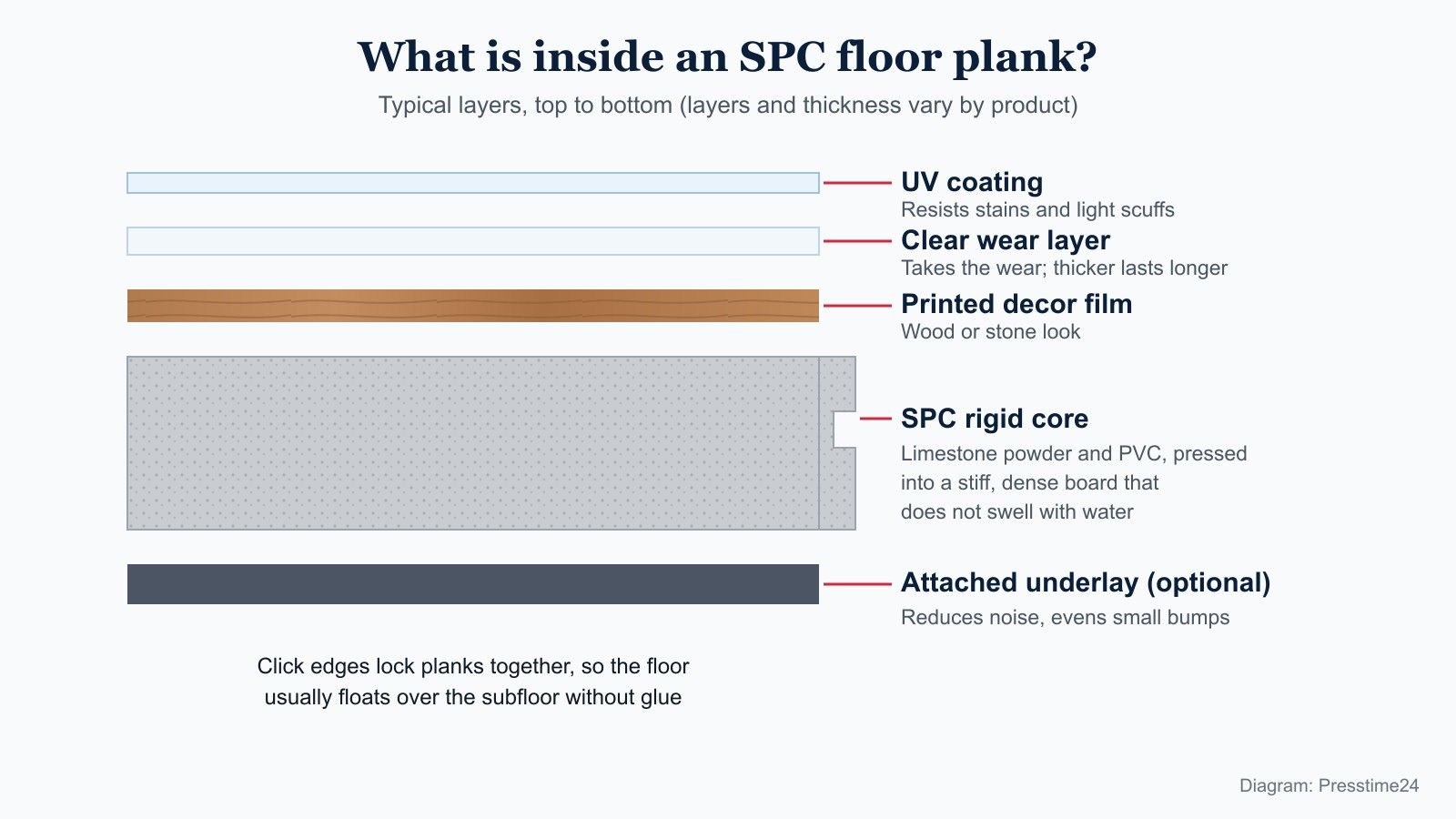
An SPC plank has several layers bonded together. From the top, there is usually a UV coating, a clear wear layer, a printed decor film with the wood or stone pattern, the rigid SPC core and, on many products, an attached underlay.
The standard that covers this kind of product is ASTM F3261, the specification for resilient flooring in modular format with a rigid polymeric core. It describes tiles or planks with a printed surface protected by a clear wear layer, built on a rigid core and sometimes an attached underlay, for both homes and commercial buildings.
The core is what makes SPC different. Because it is dense and stiff, the plank does not swell with water the way a wood based core can, and it bridges small bumps in the subfloor better than thin, flexible vinyl.
Is SPC flooring good for your home?
Yes, for many rooms and many households. It is a practical choice when the floor will see water, grit, pets or children, and when you want a wood or stone look at a lower cost than the real material.
- Use it in kitchens, bathrooms, utility rooms and hallways, where spills and wet shoes are common.
- Choose it for homes with pets, since the wear layer resists scratches better than many soft finishes.
- Consider it for rentals and busy family homes, where low upkeep matters more than a natural material.
- Lay it over many existing hard floors, such as old tiles, if they are flat and firm.
It is less suited to rooms where comfort and quiet come first, such as bedrooms in upstairs flats, unless you add a good underlay. It is also the wrong choice if you want a floor that can be sanded and refinished in 20 years, as solid wood can be.
What are the downsides of SPC flooring?
The main downsides are comfort, sound and the fact that it is plastic. A dense core feels hard and cool underfoot, and a floating floor can sound hollow or clicky without an underlay.
- Expect a harder, colder feel than wood, cork or carpet.
- Add an underlay, or buy planks with one attached, to reduce footstep noise, especially in flats.
- Prepare the subfloor carefully, because a rigid plank can flex and the click joints can break over dips.
- Protect it from very hot items, because the wear layer can mark or melt.
- Plan for replacement rather than refinishing once the wear layer is worn through.
PVC is also a plastic made from fossil fuels, and recycling options for old vinyl floors are limited in many areas. Buyers who want a lower plastic home may prefer wood, cork or linoleum.
How does SPC compare with WPC and laminate?
SPC, WPC and laminate all click together and float over the subfloor, but their cores differ. SPC uses stone and PVC, WPC uses a lighter foamed plastic core, and laminate uses a high density wood fibre board.
| What to compare | SPC floor | WPC floor | Laminate |
|---|---|---|---|
| Core | Limestone powder and PVC, dense | Foamed plastic composite, lighter | Wood fibre board |
| Water and swelling | Core does not swell | Core does not swell | Core can swell if water gets in, unless treated |
| Feel underfoot | Hard, cooler | Softer, warmer | Hard |
| Dents from heavy furniture | Resists well | Dents more easily | Resists well |
| Noise | Can sound clicky without underlay | Quieter | Can sound hollow without underlay |
| Best rooms | Kitchens, bathrooms, busy areas | Living rooms, bedrooms | Dry living areas |
Does SPC flooring affect indoor air?
New vinyl floors can release volatile organic compounds (VOCs) into the air for a while after installation. The US Environmental Protection Agency says VOCs come from many building materials and household products and that concentrations of many VOCs are higher indoors than outdoors.
The simplest check is an indoor air certificate. FloorScore, a certification from the Resilient Floor Covering Institute run by SCS Global Services, tests hard flooring against the VOC emission limits of California’s Section 01350 programme. The institute notes that certification does not cover installation, so ventilate the room well while the floor goes down and for a few days after.
What should you check before buying SPC flooring?
Check the parts you cannot see in the showroom: the wear layer, the core and the paperwork. Two floors with the same pattern can differ a great deal in how long they last.
- Compare the wear layer thickness, usually given in mil or millimetres, and choose a thicker one for busy rooms.
- Ask for the total plank thickness and whether an underlay is attached or needed.
- Check the subfloor flatness the manufacturer requires, and level the floor before laying.
- Ask whether the product meets ASTM F3261 and for an indoor air certificate such as FloorScore.
- Read the warranty for exclusions, such as direct sunlight, wet rooms or commercial use.
- Leave the boxes in the room for the time the maker specifies, so the planks adjust to the temperature.
Builders and retailers often buy SPC flooring directly from overseas suppliers. Shandong Diman International Trade Co., Ltd., a building materials supplier in Linyi, Shandong, lists SPC floor products on its website alongside SPC, WPC and PVC wall panels, and says it works with a manufacturing partner in Linyi that was set up in 2017. As with any supplier, ask for test reports and certificates for the exact product before you order.
When to get professional help
Call a professional floor fitter if the subfloor is uneven, if you plan to lay SPC in a basement or over underfloor heating, or if the area is large. Bring the product’s installation guide and warranty terms, since an installation that ignores them can void the warranty.
For more practical guides for the home, see the Lifestyle section, including our guide to matte and gloss furniture protection film.