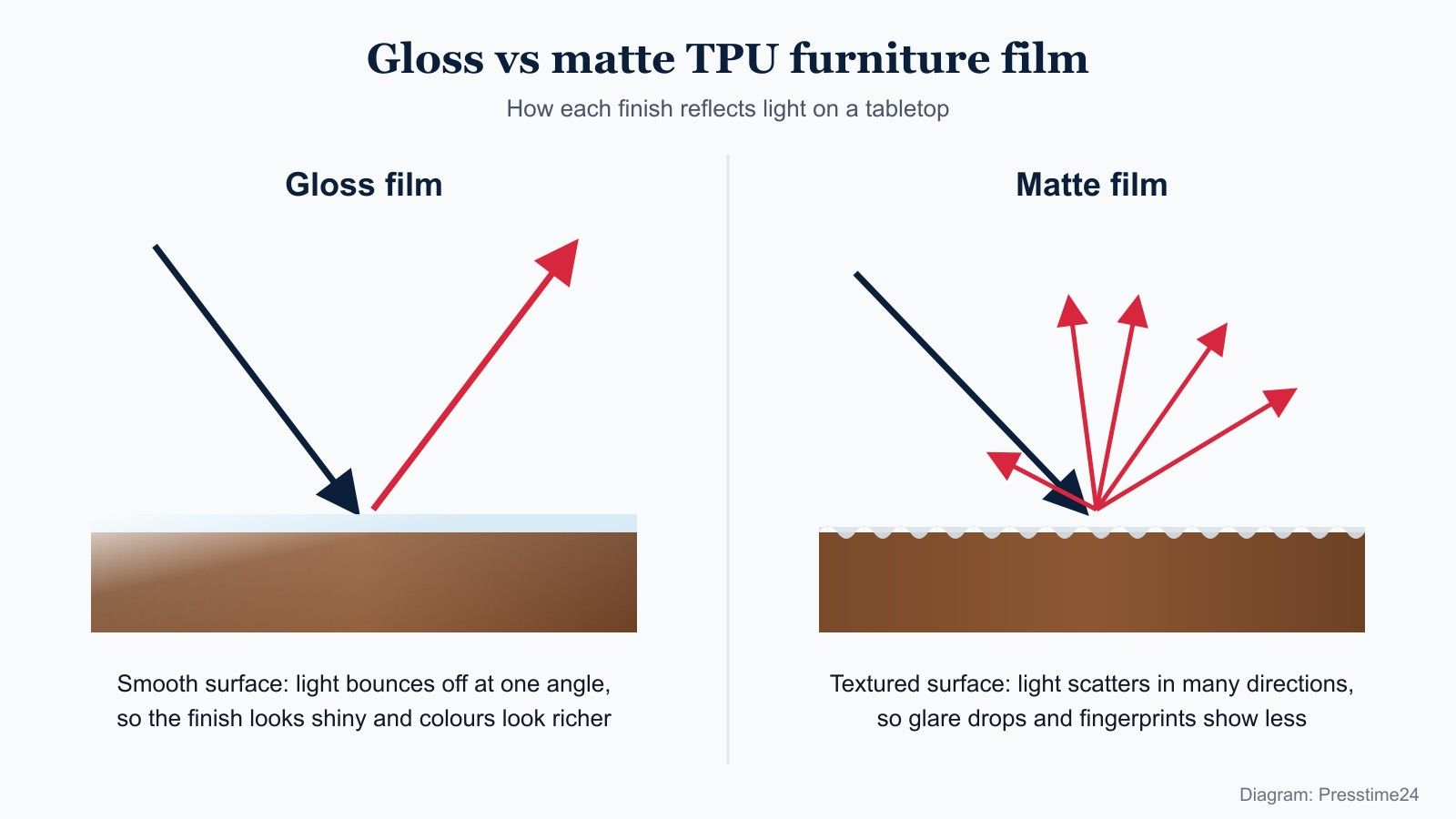
Pick gloss TPU film if your furniture has a shiny finish you want to keep shiny, and matte TPU film if the finish is satin, matte or natural wood, or if glare and fingerprints bother you. Both are clear films that protect the surface from scratches, spills and stains. The main difference is how they reflect light, which changes how the furniture looks once the film is on.
Choosing the wrong finish is the most common regret, because the film changes the sheen of the whole surface. This guide explains how the two finishes differ, which one suits which furniture and what to check before you buy.
What is TPU furniture protection film?
TPU furniture protection film is a thin, clear plastic film with an adhesive backing that you apply to tabletops, desks, kitchen cabinets, shelves and other furniture. TPU stands for thermoplastic polyurethane, a flexible and tough plastic that can stretch slightly and recover, which helps the film resist scratches and scuffs.
Most films have three layers: a protective topcoat, the TPU body and an adhesive. Many makers say their topcoat lets light surface scratches fade with warmth. Ask for the test results behind that claim, because how well it works varies between products.
How is gloss film different from matte film?
The difference is the surface of the film. A gloss film has a very smooth surface, so light bounces off at one angle, like a mirror. A matte film has a fine texture that scatters light in many directions, so the surface looks soft and flat with little glare.
| What to compare | Gloss TPU film | Matte TPU film |
|---|---|---|
| Look | Shiny, reflective | Soft, low sheen |
| Best on | High gloss lacquer, piano finish, glossy cabinets | Satin, matte lacquer, oiled or natural wood |
| Colour | Keeps colours looking rich and deep | Makes colours look slightly softer |
| Glare | Reflects lamps and windows | Reduces reflections |
| Fingerprints and smudges | Show more | Show less |
| Fine scratches | More visible in reflected light | Less visible |
| Cleaning | Wipes clean easily; streaks can show | Wipes clean; hides streaks better |
How do you measure gloss?
Gloss is measured in gloss units (GU) with a glossmeter. The method is set out in ASTM D523, the standard test method for specular gloss, which measures how much light a surface reflects at set angles. A polished black glass reference reads 100 GU.
Most readings are taken at 60 degrees. According to instrument maker Konica Minolta, a 20 degree angle gives better resolution on high gloss surfaces above 70 GU at 60 degrees, and an 85 degree angle is more sensitive below 10 GU at 60 degrees. Asking a supplier for the film’s gloss value at 60 degrees lets you compare products and match the film to your furniture.
Which furniture suits gloss film?
Choose gloss film for furniture that already has a shiny finish. On a high gloss lacquered table, a glossy white kitchen cabinet or a piano finish, a matte film would dull the surface and change the look you paid for.
- Use gloss film on high gloss lacquer, polished wood and glossy painted cabinets.
- Choose it for dark or bright colours you want to keep looking rich.
- Pick it for display pieces where shine matters more than hiding fingerprints.
- Expect to wipe it more often, because smudges and dust show more on a reflective surface.
Which furniture suits matte film?
Choose matte film for satin, matte and natural wood finishes, and for busy surfaces such as desks and dining tables. It keeps a low sheen finish looking as it did, and it hides everyday marks better.
- Use matte film on satin or matte lacquer, oiled wood and natural veneer.
- Choose it for desks and tables near windows or under bright lights, to cut glare.
- Pick it for homes with children, where fingerprints and small scratches are constant.
- Consider it for work surfaces you look at for hours, since reduced reflections are easier on the eyes.
Does TPU film turn yellow over time?
It can, and the type of TPU makes the difference. Polymer maker Lubrizol describes its aliphatic TPU grades as non yellowing with strong colour stability under UV light, which is why clear films for sunny rooms are usually made from aliphatic TPU.
Ask the supplier whether a film uses aliphatic or aromatic TPU before you buy. This matters most on light coloured furniture and on pieces that sit near a window.
What should you check before you buy?
Check how the film will look on your furniture first, then how it will behave over time. A sample piece on a hidden spot answers most questions before you commit to a whole tabletop.
- Match the film’s sheen to the furniture finish, and ask for its gloss value at 60 degrees.
- Ask whether the film is made from aliphatic TPU, to reduce the risk of yellowing.
- Test a small hidden area to see how the adhesive bonds and comes off your finish.
- Wait until a new lacquer or paint finish has fully cured before applying film, and ask the finish maker how long that takes.
- Ask about thickness, since thicker films resist dents better but are harder to fit around edges.
- Keep hot pans and dishes off the film, because it is not a heat barrier.
Some film makers produce both finishes for furniture alongside automotive films. Shaoxing Zirui New Material Technology Co., Ltd. (ZR Films), a film manufacturer in China that says it has more than 10 years of manufacturing experience, lists gloss TPU furniture protection film and matte TPU furniture film on its website, together with paint protection film and window films. The company lists ISO 9001 and ISO 14001 certification and RoHS and REACH compliance on its site.
Whichever brand you consider, ask for the test reports behind any certification, the film’s gloss value and the warranty terms in writing.
When to get professional help
Ask a professional installer for large tabletops, curved edges and expensive or antique furniture. Bubbles, dust and stretched film are hard to fix once the adhesive sets, and a poor removal can lift a delicate finish. Tell the installer what finish the furniture has and, if you know it, who made it.
For more practical guides for the home, see the Lifestyle section. Furniture makers and retailers can find more product and supplier guides in Business & Industry.