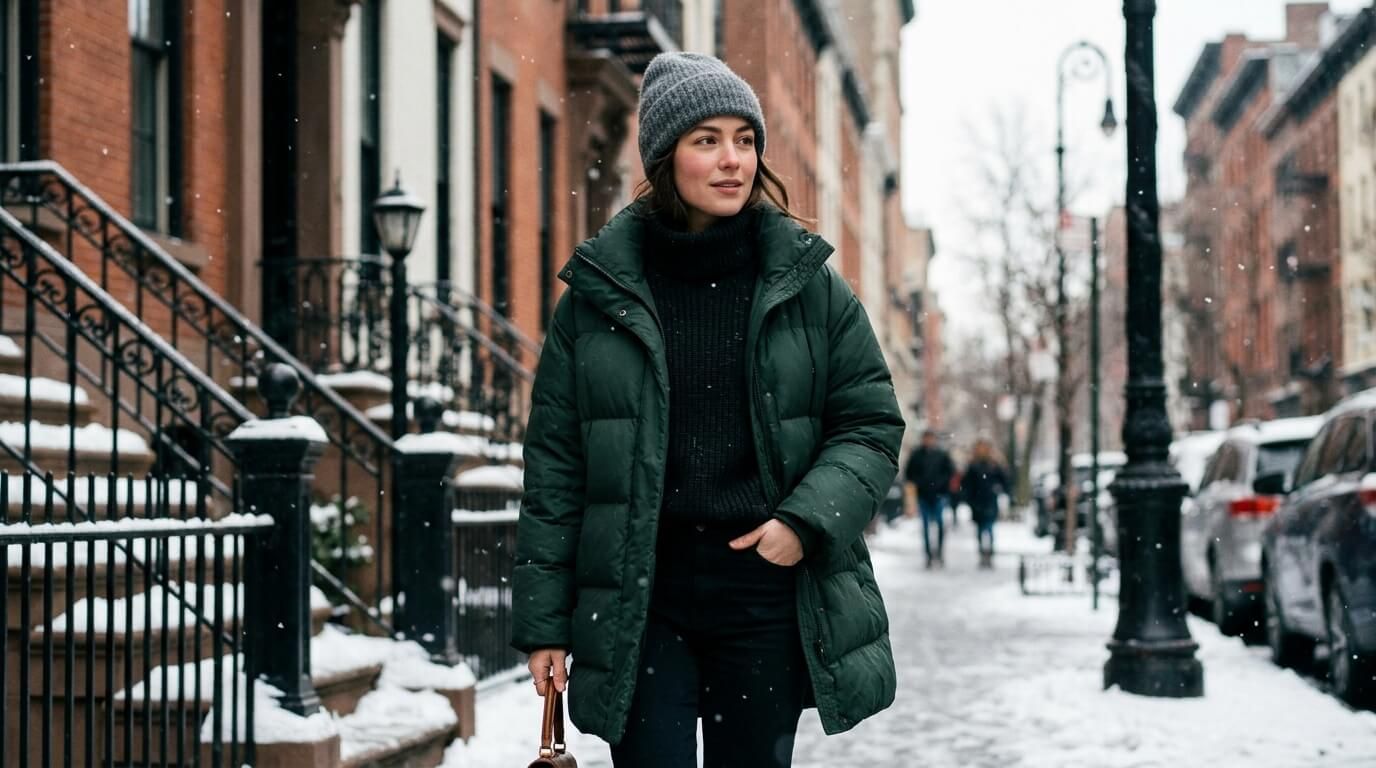
Most women’s winter jackets fall into five types: puffers, parkas, wool coats, waterproof shells and fleeces. Each type handles cold, rain and wind differently, so the right choice depends on your local weather and how long you spend outdoors each day.
Picking the wrong type is an easy and expensive mistake. A warm down puffer can lose its warmth in steady rain, and a waterproof shell gives very little warmth by itself. Labels such as “water resistant” and “600 fill power” make the choice harder if you don’t know what they mean.
This guide explains each type and its labels, then gives a short checklist to use in the shop.
Winter jacket types at a glance
| Type | Best for | Main drawback |
|---|---|---|
| Puffer | Cold, dry days and everyday wear | Often only water resistant |
| Parka | Very cold, windy weather and long spells outside | Heavy and bulky indoors |
| Wool coat | Work and evenings out in dry cold | Usually not waterproof, and heavy when soaked |
| Waterproof shell | Rain and wind, worn over warm layers | Little warmth on its own |
| Fleece | Mild, dry days or as a middle layer | Wind passes straight through |
What are the main types of winter jacket for women?
Puffer jacket
A puffer is a quilted jacket filled with down, the soft clusters that grow under the feathers of ducks and geese, or with a synthetic fibre such as polyester. Stitched sections called baffles stop the filling from slipping to the bottom.
Short puffers, and those that stop at the hip, are easy to move in. Long styles that reach the knee keep your legs warm while you wait at a bus stop. Many puffers have a water resistant outer fabric rather than a fully waterproof one, so check the label if you live somewhere wet.
Parka
A parka is a longer hooded coat, usually reaching the middle of the thigh or the knee, with an insulated lining and a tougher outer fabric. Many have a drawstring waist and a fur or faux fur trim on the hood, which helps shield your face from wind.
Parkas suit very cold, windy weather and long spells outdoors. They can feel heavy on a crowded bus or in a warm shop.
Wool coat
Wool coats include the long tailored overcoat and the shorter peacoat with two rows of buttons. They look smart enough for the office or an evening out, and wool is warm in dry cold. Most wool coats are not waterproof, though, and they get heavy when soaked, so you may need an umbrella on wet days.
Waterproof shell or rain jacket
A shell is a thin outer jacket with no insulation of its own. It keeps rain and wind out while you wear warm layers underneath, which makes it useful from autumn to spring. On a cold, dry day, a shell by itself will leave you chilly.
Fleece and light quilted jackets
A fleece is a soft synthetic jacket that is warm for its weight and dries quickly. Wind passes straight through it, so it works best as a middle layer under a shell, or alone on mild, dry days. A thin quilted jacket does a similar job.
Should you choose down or synthetic insulation?
Choose down for cold, dry weather and synthetic insulation for damp weather. According to outdoor retailer REI, down gives more warmth for its weight, packs very small and lasts well. It also loses its insulating power when wet, needs special care when washing and costs more than synthetic fill.
Synthetic insulation, usually polyester, keeps insulating when damp and dries quickly. For the same warmth it tends to be a little heavier and bulkier than down. REI says some down is now treated to resist light moisture, but that treatment is meant for drizzle, so a waterproof outer layer still matters in real rain.
What does fill power mean on a down jacket?
Fill power measures how much space one ounce of down fills, in cubic inches. REI explains that down with a fill power of 600 fills 600 cubic inches, and premium goose down can reach 900 or higher.
A higher number means the jacket needs less down for the same warmth, so it can be lighter. Fill power describes the quality of the down, not how much of it is inside.
Is a water resistant jacket enough for rain?
It is fine for drizzle but not for long or heavy rain. Cotswold Outdoor’s buying guide says waterproof jackets use membranes, coatings and sealed seams to keep out heavy rain, while water resistant jackets rely on a surface finish that copes with drizzle or brief showers.
Look for taped seams on the label. Without them, water can get in through the stitch holes, even when the fabric itself is waterproof.
What waterproof rating do you need?
For everyday use in light showers, a hydrostatic head of 1,500 to 5,000mm is generally enough, according to the same guide. For hiking or heavy rain, it suggests 10,000 to 20,000mm. The figure, shown in millimetres, measures how much water pressure the fabric can take before it starts to leak.
How do you stay warm without a bulky coat?
Wear several thin layers under a lighter jacket. The charity Age Cymru says several thin layers keep you warmer than one thick layer, and that clothes made from wool, cotton or fleecy synthetic fabrics are best. It also recommends a hat, and a scarf over your mouth and nose.
Layers help indoors too. You can take off a jumper on a warm train instead of sitting in a heavy coat.
What to check before you buy
- Match the jacket to your weather, because dry cold suits down or wool and wet cold suits synthetic fill or a waterproof shell.
- Try it on over a thick jumper, so you know it still fits when you layer up.
- Lift your arms and cross them in front of you to check that the back and shoulders don’t pull tight.
- Choose the length for your routine. Hip length is easier for driving and cycling, while knee length is warmer when you stand outside.
- Check that the hood stays up in the wind and that the cuffs close around your wrists.
- Read the care label before you pay, since down usually needs special washing.
Which winter jacket is best for you?
For a typical damp, cool winter, a puffer or parka with synthetic filling covers most days, with a waterproof shell for walks in steady rain. If your winters are colder and drier, a down puffer gives the most warmth for its weight. A wool coat is the better choice for the office or an evening out.