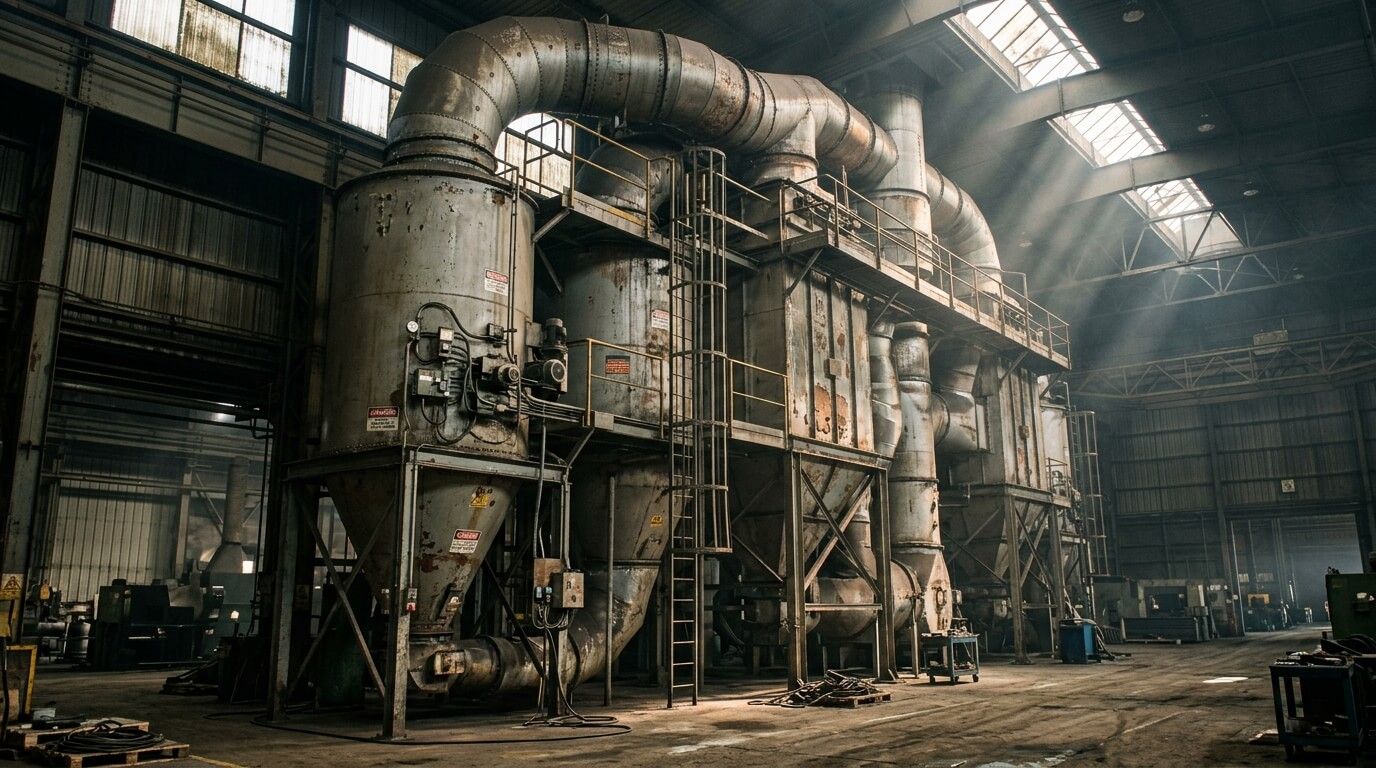
An industrial dust collector is a system that pulls dusty air away from a machine or process, traps the dust and sends cleaner air back into the room or outside. Most use fabric bags, pleated cartridges or a spinning cyclone to separate the particles, and a fan to keep the air moving.
Dust in a factory is more than a cleaning problem. It can harm the lungs of the people who breathe it, damage equipment and, for many materials, catch fire or explode. This guide explains how a dust collector works, how the main types compare and what to check when you choose one.
How does an industrial dust collector work?
Every dust collector does three jobs: it captures dusty air at the source, separates the dust from the air and stores the dust for disposal. A typical system has a hood or pickup point near the machine, ductwork, the collector itself, a fan that pulls air through the whole system, and a hopper or bin underneath that catches the dust.
The separation step is where the designs differ. Filter types push air through a fabric or paper medium that holds back the particles, while a cyclone spins the air so that heavier particles are thrown out of the flow.
How do filter bags and cartridges stay clean?
Many filter collectors clean themselves with short blasts of compressed air. According to a US EPA fact sheet on baghouses, dusty air flows from the outside of each bag to the inside, so dust builds up on the outer surface. A burst of air lasting 0.03 to 0.1 seconds, at 60 to 120 psi, then flexes the bag and knocks the dust cake loose so it falls into the hopper.
Because each pulse is so short and the bags are cleaned row by row, the collector keeps filtering while it cleans. The EPA says this method, called pulse jet cleaning, has grown steadily in popularity because it handles heavy dust loads and takes up less space.
What are the main types of dust collector?
| Type | How it separates dust | Where it fits best | Main limits |
|---|---|---|---|
| Baghouse (fabric filter) | Long fabric bags hold back dust as air passes through | Large air volumes and heavy dust loads, such as cement, foundries and boilers | Large footprint; regular bag replacement |
| Cartridge collector | Pleated cartridges give a lot of filter area in a small space | Lower air volumes, such as welding, machining, blasting and grinding | Less suited to very high air flows or sticky, moist dust |
| Cyclone | Spinning air throws particles outward into a hopper | Coarse dust, or as a first stage in front of a filter | Weak on fine particles; parts wear from abrasive dust |
Other designs, such as wet scrubbers and electrostatic precipitators, are used for some specific processes and are not covered in detail here.
How efficient is a baghouse?
New baghouse designs are built to capture 99 to 99.9 per cent of particulate matter, according to the EPA, and older units in use typically achieve 95 to 99.9 per cent. Bags can be 6 to 9 metres long, and with the right fabric a baghouse can handle gas at up to about 260°C (500°F).
Why choose a cartridge collector?
Cartridge collectors catch finer dust in a much smaller box. The EPA’s fact sheet on cartridge collectors gives design efficiencies of 99.99 per cent or more for new equipment and says a cartridge unit can be about four times smaller than a baghouse for a similar air stream. The trade off is a limit on size: standard units handle up to roughly 5 cubic metres of air per second, and paper cartridges are rated for gas at up to about 95°C (200°F).
Cartridges are also changed from outside the collector, which reduces how much dust maintenance workers are exposed to. The EPA notes that cartridge collectors usually cost less to buy than a baghouse but more to run and maintain.
What does a cyclone do?
A cyclone uses centrifugal force instead of a filter. The EPA explains that as dusty gas spirals through the cyclone, larger particles move to the walls and drop into a hopper. Cyclones mostly collect particles bigger than about 10 micrometres, so they often work as a first cleaning stage that removes coarse, abrasive dust before a baghouse or cartridge collector.
Why can dust collectors be a fire and explosion risk?
Many dusts burn, and a collector concentrates them in one place. The EPA’s fact sheets warn that dust concentrations of about 50 grams per cubic metre inside a collector can be a fire or explosion hazard if a spark or flame gets in.
The scale of the problem is well documented. The US Chemical Safety Board identified 281 combustible dust incidents in US industry between 1980 and 2005, which killed 119 workers and injured 718. The industries affected included rubber and plastics, chemicals, metals, wood products and food. The board recommended a national safety standard based on existing National Fire Protection Association codes, such as NFPA 654.
How do you choose the right dust collector?
Start with the dust, not the machine. The size, stickiness, temperature and flammability of the particles decide which type will work. Then check the details below before you buy:
- Test or identify the dust, because its particle size and whether it can burn decide the collector type and the safety features you need.
- Measure the air flow at each pickup point, since an undersized fan or duct leaves dust in the room however good the filter is.
- Check the gas temperature and moisture, as hot or damp air can damage filter media or clog it.
- Ask for the filter media rating and the expected efficiency for your particle size, in writing.
- Plan for safe filter changes, especially if the dust is hazardous to breathe.
- Ask how the design handles combustible dust, such as explosion vents, isolation valves or spark detection.
- Compare running costs as well as the purchase price, including compressed air, energy and replacement filters.
Manufacturers publish specifications that make this comparison easier. For example, Jiangsu Renhe’s industrial dust collectors include baghouse and cartridge models, according to the company, which is based in Jiangyin in China’s Jiangsu Province and also makes filter cartridges and welding fume extractors. Whichever supplier you consider, ask for test data that matches your own dust and air flow.
A dust fire or a worker’s injury can also become an insurance claim. Our guide on how business insurance protects your company explains employers’ liability and property cover.
When to get professional help
Bring in a qualified ventilation or process safety engineer if your dust can burn, if workers are exposed to fine or toxic dust, or if the system serves several machines. Share a sample or safety data sheet for the dust, the air flow at each machine, and any local rules your site must follow.
This article is general information and is not engineering, safety or legal advice. Rules on dust control and explosion protection differ between countries, so check the requirements where your site operates.