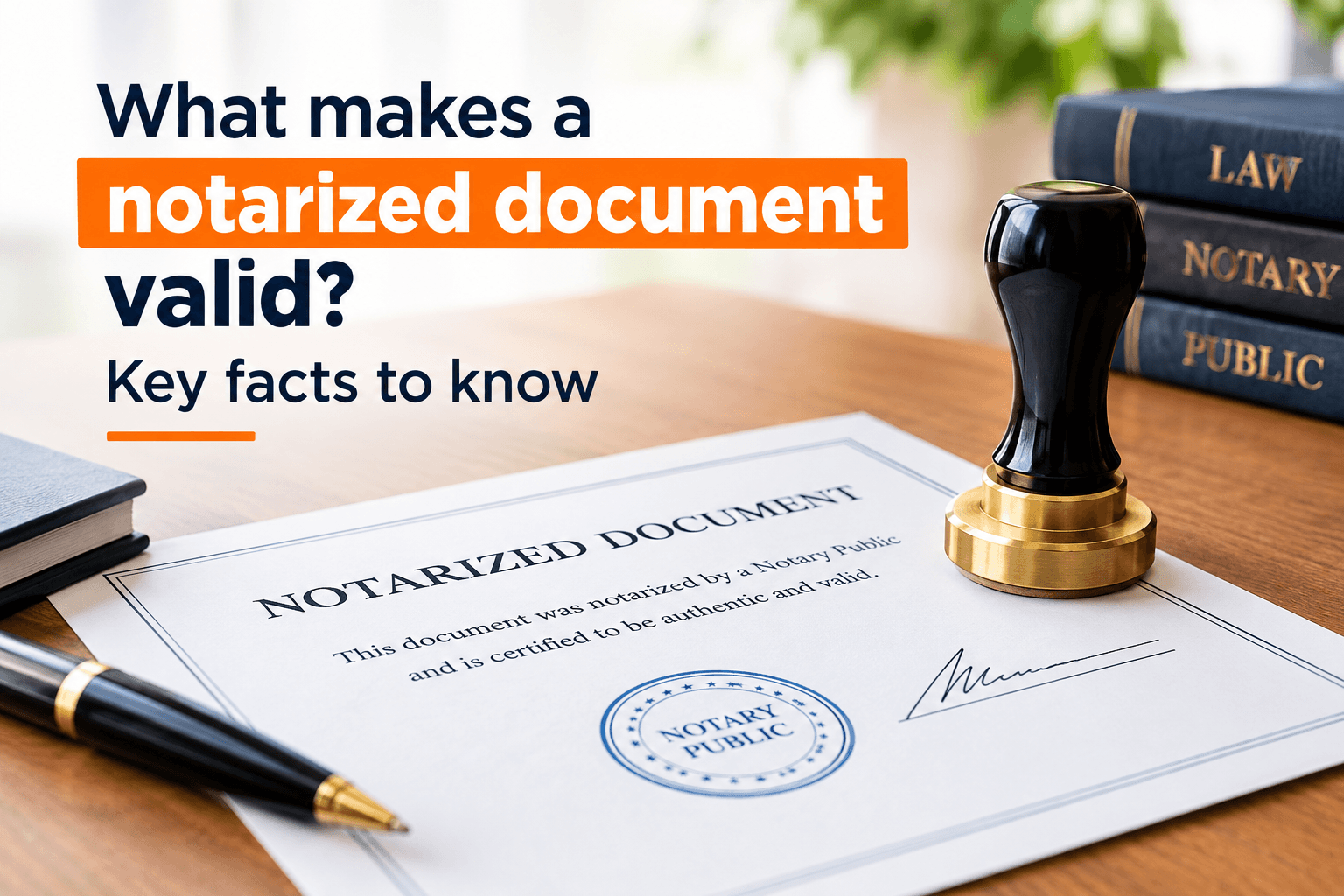
A notarized document is valid when a commissioned notary has checked the signer’s identity in person and completed a proper certificate, signed, dated and stamped where the law requires it. The notarization covers the signature only. It says nothing about whether the document’s contents are true or legally sound.
That gap catches many people out. Banks, courts and foreign authorities can reject paperwork when the certificate is incomplete, which can hold up a property sale or a power of attorney. This guide explains what a notary checks, what a valid certificate contains and what to do before your appointment.
Notary rules differ between US states and between countries. The examples below come from Arizona’s notary law, which is based on the Revised Uniform Law on Notarial Acts, a model law written for states to adopt.
What does a notary actually check?
A notary checks that the person signing is who they claim to be. Under Arizona law, the notary must confirm that the individual appearing before them “has the identity claimed” and, for an acknowledgment, that the signature on the record is that person’s own.
Does notarization make a document legal?
No. California makes this point on the certificate itself. Its Civil Code requires a notice on acknowledgment certificates saying the notary “verifies only the identity of the individual who signed the document”, and not the truthfulness, accuracy or validity of that document.
A contract with missing terms is still flawed after it has been notarized. If you need to know whether a document will hold up, ask a lawyer before you sign it.
What makes a notarization valid?
Under Arizona’s law, a notarization has to meet the conditions below. Other states have their own rules, so the details can vary.
- The signer appears before the notary.
- The notary confirms the signer’s identity, through personal knowledge, an accepted ID or a credible witness.
- The notary has no stake in the document.
- The notary completes the certificate at the time of the notarial act, then signs and dates it, naming the jurisdiction and their title.
- On a paper document, the notary attaches an official stamp to the certificate.
What ID do you need for a notarization?
Usually an unexpired photo ID issued by a government. Arizona accepts an unexpired US passport, a state driving licence or a state nonoperating ID card. It also accepts other unexpired government ID that carries your signature or a photo and physical description.
If you have no suitable ID, a credible witness who appears with you and is known to the notary can confirm your identity on oath or affirmation. The notary can also ask for more information or another document if they are not satisfied.
What happens if the notary has a conflict of interest?
The notarization can be challenged. Arizona law says a notary may not notarize a record if the notary or the notary’s spouse is a party to it or has a direct beneficial interest in it. A notarial act done in breach of that rule is voidable, which means a court can set it aside if someone challenges it.
Is a notarization valid if the stamp or date is missing?
It may not be. In Arizona, the certificate must be signed and dated by the notary, and a paper certificate must carry the official stamp. An office receiving the document can refuse one with missing parts, so check the certificate before you leave the appointment.
What to do before and after your appointment
Most problems with notarized documents are easy to avoid if you prepare.
- Bring an unexpired government photo ID, because the notary has to confirm who you are.
- Wait to sign until the notary tells you to, since some notarial acts require the notary to watch you sign.
- Fill in every blank space in the document beforehand, so nothing can be added after it is notarized.
- Use a notary who has no stake in the document, because an interested notary’s act can be challenged.
- Check the finished certificate for the notary’s signature, the date, the place and the stamp.
- Ask the organisation that wants the document which certificate wording it needs, as requirements differ.
- Keep a copy of the notarized document for your own records.
Using a notarized document in another country
You may need an apostille as well. An apostille is a single certificate that lets a public document from one country be used in another. It replaced the older, slower legalisation process for countries that signed the Apostille Convention of 5 October 1961, which has 130 contracting parties, according to the Hague Conference on Private International Law.
In the UK, the Legalisation Office checks that the signatures, stamps or seals on a document match its records before it attaches an apostille, GOV.UK says. Documents such as a power of attorney or a contract qualify if a UK public official, such as a notary or solicitor, has certified them.
Can a document be notarized online?
In some places, yes. Several US states allow notarization over a live video call, known as remote online notarization, under their own rules. Before you use one, check that the notary is commissioned in a state that allows it and that the organisation receiving the document will accept it.
When to get professional help
Speak to a qualified lawyer or solicitor if the document transfers property, appoints someone under a power of attorney or will be used in court. Bring the unsigned document, your ID and any instructions from the organisation that asked for it.
This article is general information and is not legal advice. Notary rules differ between states and countries, so check the rules where the document will be signed and used.