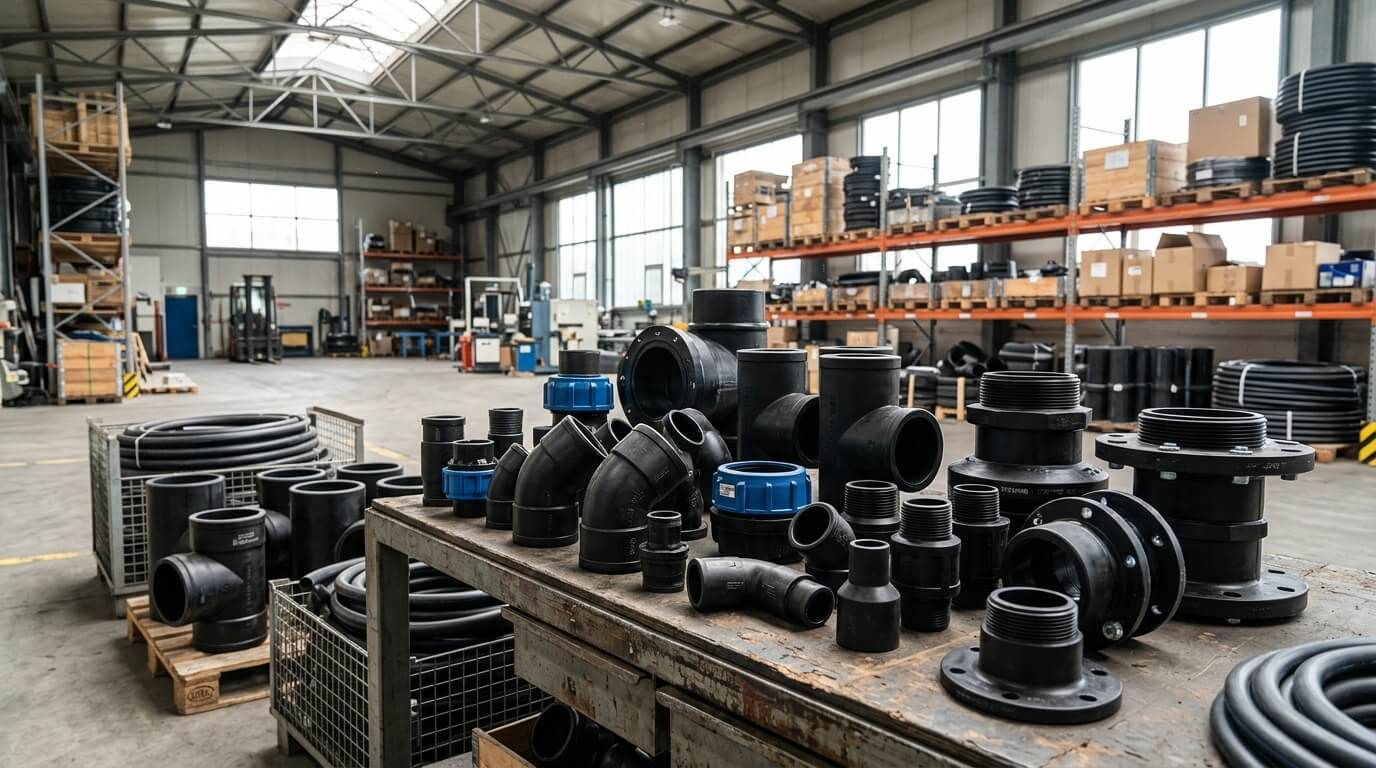
PE pipe fittings are the parts that connect, branch, reduce, turn and close off lengths of polyethylene pipe, such as elbows, tees, couplings, reducers and end caps. Most of them are joined by heat fusion: the pipe and fitting are heated until the plastic melts, then pressed together so they become one piece.
PE pipe carries drinking water, gas, sewage and industrial liquids, and a pipe line is only as reliable as its joints. Polyethylene is usually joined with heat, while metal pipe often uses threads and PVC pipe often uses solvent cement. This guide explains the main types of PE pipe fittings, how each joining method works and what to check before you choose them.
What are PE pipe fittings?
PE pipe fittings are the components that join pipes or change the direction, size or flow of a polyethylene pipe system. PE stands for polyethylene, a tough, flexible plastic, and the version most often used for pressure pipes is high density polyethylene (HDPE).
Fittings come in the same shapes as for other pipe materials:
- Couplings join two straight lengths of pipe.
- Elbows change the direction of the line.
- Tees and saddles add a branch.
- Reducers connect pipes of different sizes.
- End caps close off a line.
- Flange adapters and stub ends connect PE pipe to metal flanges or let a section be taken apart later.
How do PE pipe fittings work?
Most PE fittings work by heat fusion. The Plastics Pipe Institute, the trade association for the plastic pipe industry in North America, describes the principle simply: heat two surfaces to a set temperature, then press them together with enough force for the melted plastic to flow and mix.
When the joint is made according to the pipe or fitting maker’s procedure, the institute says the joint becomes as strong as, or stronger than, the pipe itself in both tensile and pressure properties. Once it has cooled to near the surrounding temperature, it can be handled.
Which joining method suits which fitting?
| Method | How it works | Typical use |
|---|---|---|
| Butt fusion | Pipe ends are faced, heated and pressed together | Joining straight lengths and fittings with the same outside size; the most widely used method |
| Socket fusion | The outside of the pipe and the inside of the fitting socket are heated, then the pipe is pushed in | Smaller pipes; holding equipment is needed above 2 inch copper tube size |
| Saddle (sidewall) fusion | A curved saddle fitting is heated and fused onto the side of the pipe | Adding a branch to an existing line |
| Electrofusion | A heating wire built into the fitting is powered by a control box | Electrofusion couplings and saddle fittings |
| Mechanical | Rubber seals and grip rings clamp onto the pipe | Small service lines, repairs and joins to PVC, steel or cast iron pipe |
The heat fusion methods are covered by ASTM F2620, the standard practice for heat fusion joining of PE pipe and fittings. It applies to PE gas pipe, drinking water pipe and general purpose PE pipe used in pressure, low pressure and non pressure lines.
How does butt fusion work?
Butt fusion joins two pipe ends, or a pipe and a fitting, face to face. The Plastics Pipe Institute calls it the most widely used method for joining lengths of PE pipe, and says it gives a permanent, economical joint that does not restrict the flow. The institute lists six steps:
- Clean, clamp and align the pipe ends in the fusion machine.
- Face the ends so they are clean, parallel and square to the centre line.
- Align the pipe ends again.
- Melt the ends against a heating plate.
- Join the ends by applying the correct fusion force.
- Hold the joint under pressure until it cools.
Fusion machines are available for pipe up to 65 inches (about 1.65 metres) across, the handbook notes.
How is electrofusion different?
In electrofusion, the heat comes from inside the fitting instead of from a separate heating tool. The fitting contains a conductor at the joint surface. The installer scrapes and cleans the pipe, marks the insertion depth, clamps pipe and fitting, then connects a control box that sends an electric current through the fitting for a set time, often read from a barcode supplied with the fitting.
The last step in the institute’s procedure is to document each fusion. That record helps show later that every joint was made correctly.
When are mechanical fittings used?
Mechanical fittings are used where fusion is not practical or where PE meets another pipe material. Compression couplings, for example, have a body, a threaded nut, a rubber seal ring, an internal stiffener and sometimes a grip ring. The institute says this style is normally used on gas or water service lines of 2 inch iron pipe size and smaller.
Two details matter. A stiffener must support the inside of the pipe under the seal, or the seal and grip can fail. And under pressure PE pipe expands slightly and shortens, which over a long run can pull apart mechanical joints that are not restrained, so restraints or anchors may be needed.
What to check before you choose PE pipe fittings
Matching the fitting to the pipe and the job matters more than the brand name. Work through these checks with your supplier:
- Confirm the pipe size system, such as iron pipe size, copper tube size or metric, because fittings must match the pipe’s outside diameter.
- Check that the fitting suits the pipe’s wall thickness and pressure class.
- Ask for the manufacturer’s written fusion procedure and follow it exactly, since times, temperatures and forces vary by product.
- Use trained, qualified installers, as the Plastics Pipe Institute recommends for every joining method.
- Choose restrained mechanical fittings where the pipe could pull out of the joint, and always fit the stiffener.
- Keep a record of every fusion joint, as the institute recommends for electrofusion, so each one can be checked later.
Fittings are made by many manufacturers around the world. For example, Anhui Weidong’s PE pipe fittings are part of a range that also covers UPVC, CPVC, PPH and PVDF pipes and fittings, according to the company, which is based in Huoshan County in China’s Anhui Province. Whichever supplier you consider, ask which standards each fitting is made and tested to, and for its fusion instructions.
When to get professional help
Use a qualified pipe installer or engineer for any gas line, for drinking water mains, and for pressure systems in industrial plants. In the United States, the institute notes that people who join PE pipe for gas must also meet federal pipeline safety rules. Have the pipe specification, the fluid and pressure, and the fitting maker’s instructions ready when you speak to them.
This article is general information and is not engineering or legal advice. Pipe codes and installer requirements differ between countries, so check the rules where the work will be done.